Storms move through the Roanoke Valley differently depending on the season and, honestly, depending on which ridge a given roof sits closest to. Summer brings fast-building thunderstorms off the Blue Ridge with hail and sudden wind gusts; winter brings ice systems that stress flashing and edge metal. Repairing the aftermath means understanding the specific mechanism that caused the damage rather than simply patching whatever's visibly torn.
Buildings sitting closer to the surrounding ridgelines - near Mill Mountain, or up toward the higher ground on the valley's edges - see different sustained wind behavior than roofs down on the valley floor. Wind funneling and accelerating around terrain features can produce localized uplift on a roof that a flatter, more sheltered site nearby never experiences. We factor site elevation and terrain exposure into how we assess and repair wind damage, since the same storm can leave very different damage patterns on two buildings a mile apart.
Uplift damage often starts at corners and perimeter edges, where wind pressure concentrates. A membrane that looks intact from the ground can have compromised fastening at these zones that only shows up on close inspection after a wind event.
Hail from summer storms can bruise or puncture membrane depending on stone size and membrane age. Fresh, flexible membrane sometimes absorbs hail impact without visible damage; older, UV-brittled membrane cracks more readily under the same impact. We inspect systematically after a hail event, checking beyond obvious punctures for bruising that can develop into a leak months later as the compromised spot degrades further.
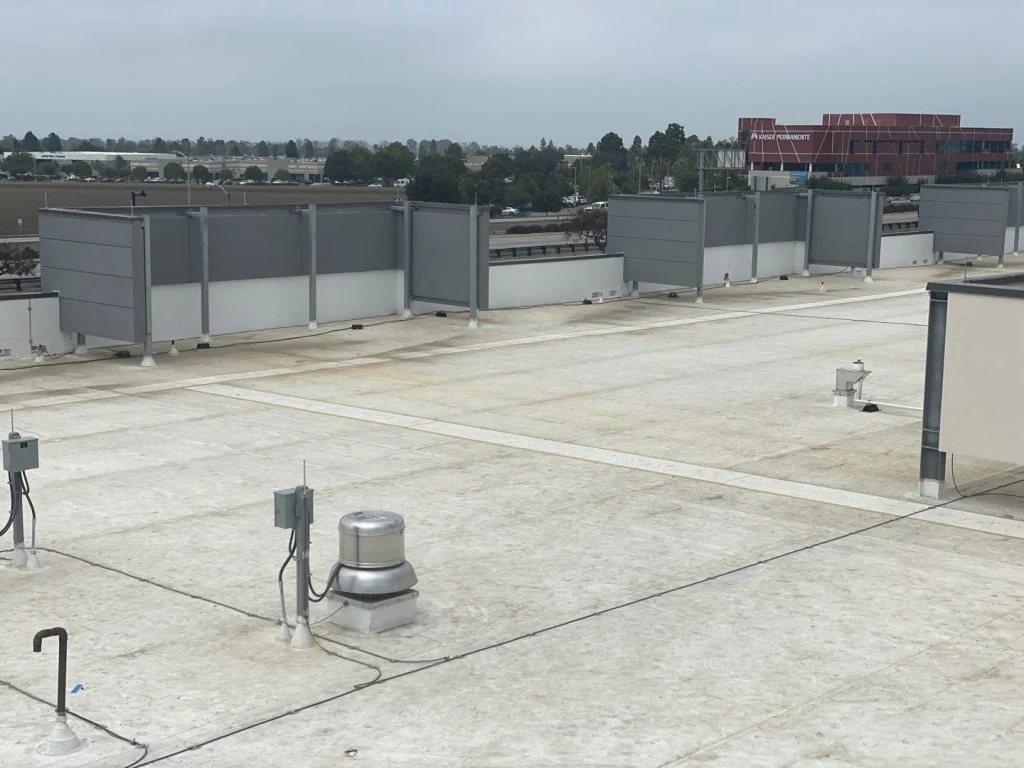
We also check rooftop equipment - HVAC housings, vent caps, exhaust hoods - since hail damage to equipment often accompanies roof damage and gets missed if the inspection only looks at the membrane itself.
A wind event and a hail event leave different fingerprints, and mixing up the diagnosis leads to the wrong repair. Wind damage tends to cluster at edges, corners, and any spot where the membrane has a seam or termination bar nearby - the failure starts at a weak point and propagates from there. Hail damage is more evenly distributed across the field, showing up wherever a stone happened to land with enough force, though roof slope and prevailing wind during the storm can concentrate hits on one side of a building over another.
We've also handled combination events here, where a single storm system brings damaging wind gusts followed by hail as the front passes through. Sorting out which damage came from which mechanism matters for the repair scope and for how the finding gets documented, since a roof with both wind and hail damage needs a broader inspection than either alone would call for.
Winter systems here can bring ice accumulation that stresses edge metal and flashing joints, particularly where drainage has been marginal and water has had a chance to pond and freeze at transitions. We see this most on roofs with pre-existing slope or drainage problems, where a winter storm turns a slow leak risk into an active one once ice forms and expands at a weak joint.
Not every storm-damaged roof needs a full section replacement, but we won't tell you that if it isn't true. If damage is isolated to a specific area and the surrounding membrane is in good condition, a targeted repair is the right call. If the storm exposed the fact that the membrane was already near end of life across a wider area, we'll say so and lay out the repair-versus-replace tradeoff honestly.
We document damage thoroughly with photos and a written condition report tied to specific roof locations, which supports whatever claim process you're running with your carrier. We describe what we find factually and don't speculate on claim outcomes.
As soon as it's safe to get crews on the roof. Some damage, like hail bruising or loosened fastening, isn't visible from the ground and worsens the longer it goes unaddressed.
Yes. Bruised membrane can look fine initially and develop into a crack or leak weeks or months later as the compromised material continues to degrade under normal weathering.
No. Loosened or backed-out fastening from uplift stress can exist without any visible membrane damage until the next wind event finishes the job. That's why we check fastening at corners and perimeters even when the surface looks intact.
We document damage and repairs in a format that supports claims regardless of carrier. The claim process itself is handled between you and your insurance company.
The diagnostic process is similar, but storm repair carries more documentation requirements for insurance purposes and often involves assessing a wider area than a single reported leak, since one storm event can damage multiple locations on the same roof.