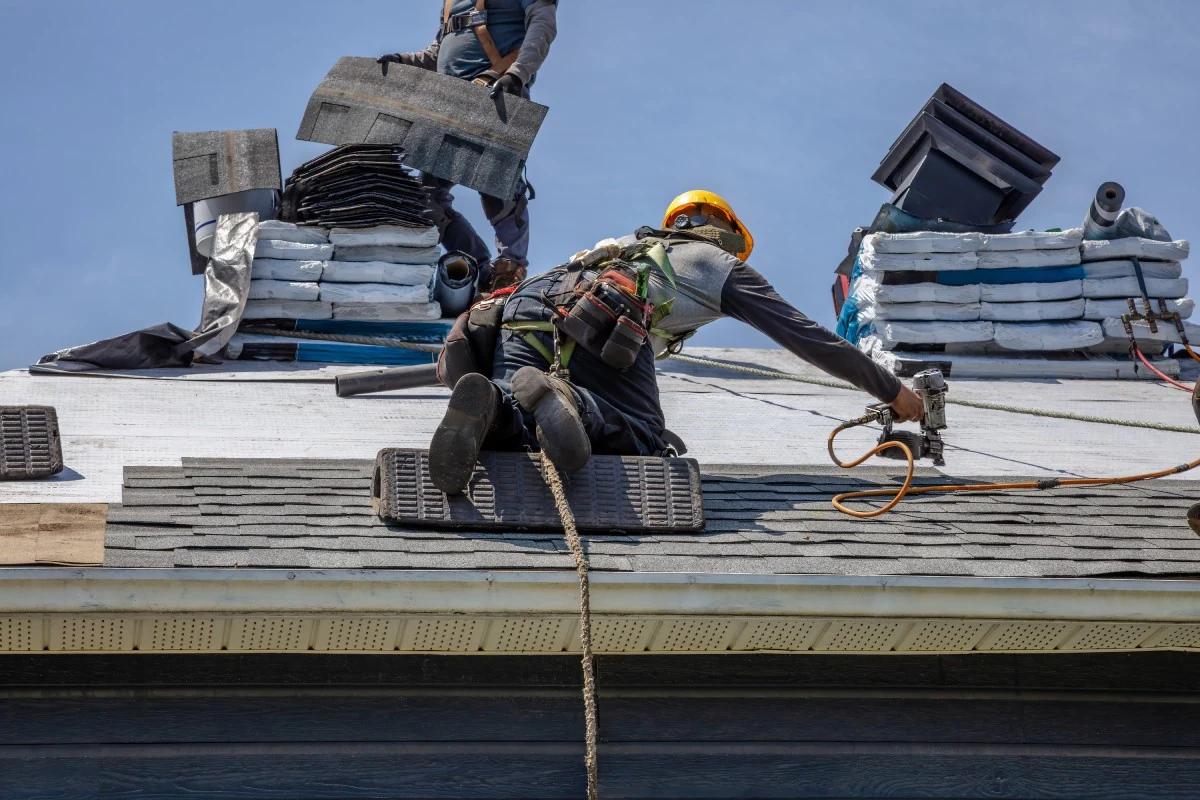
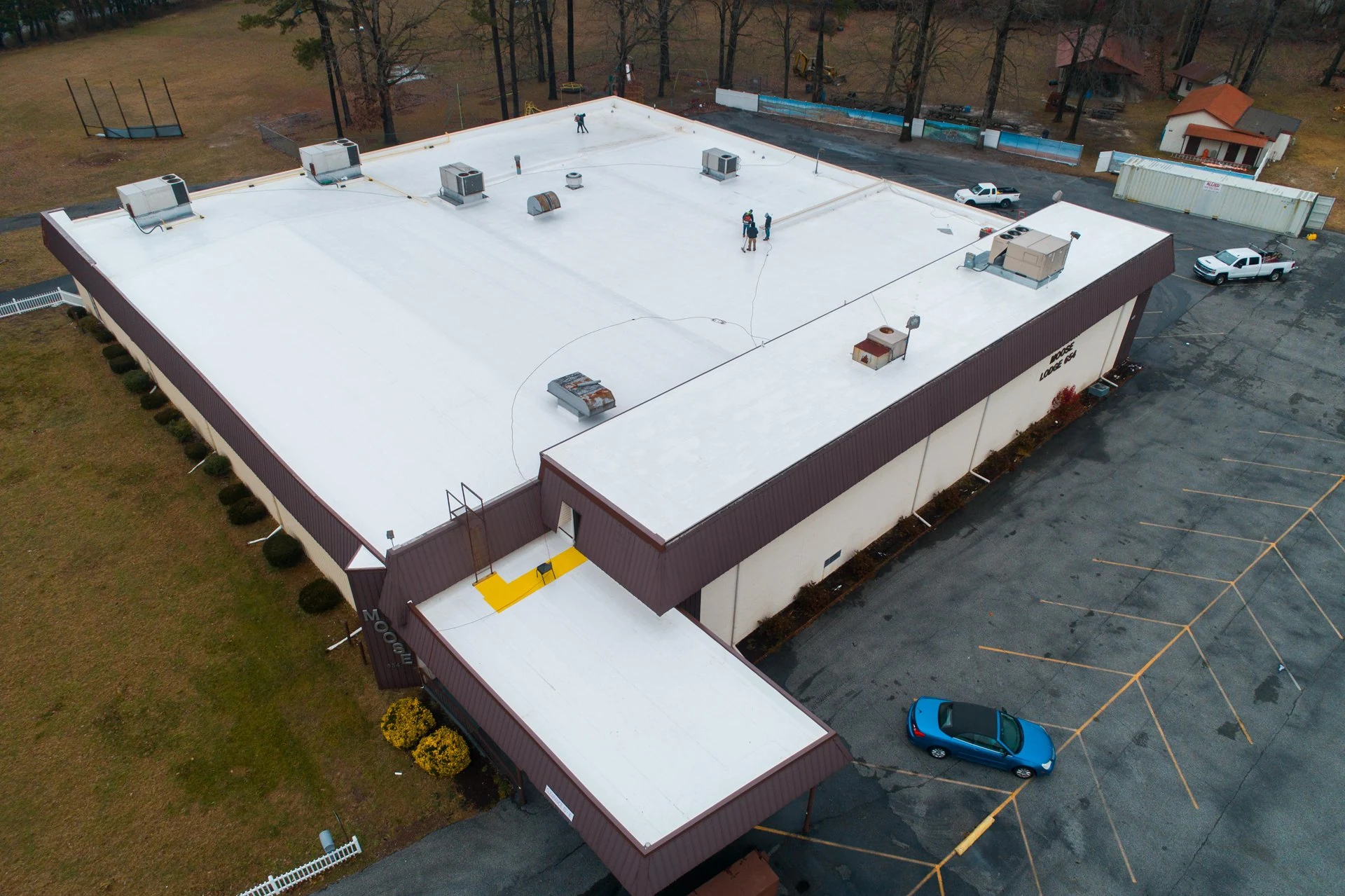
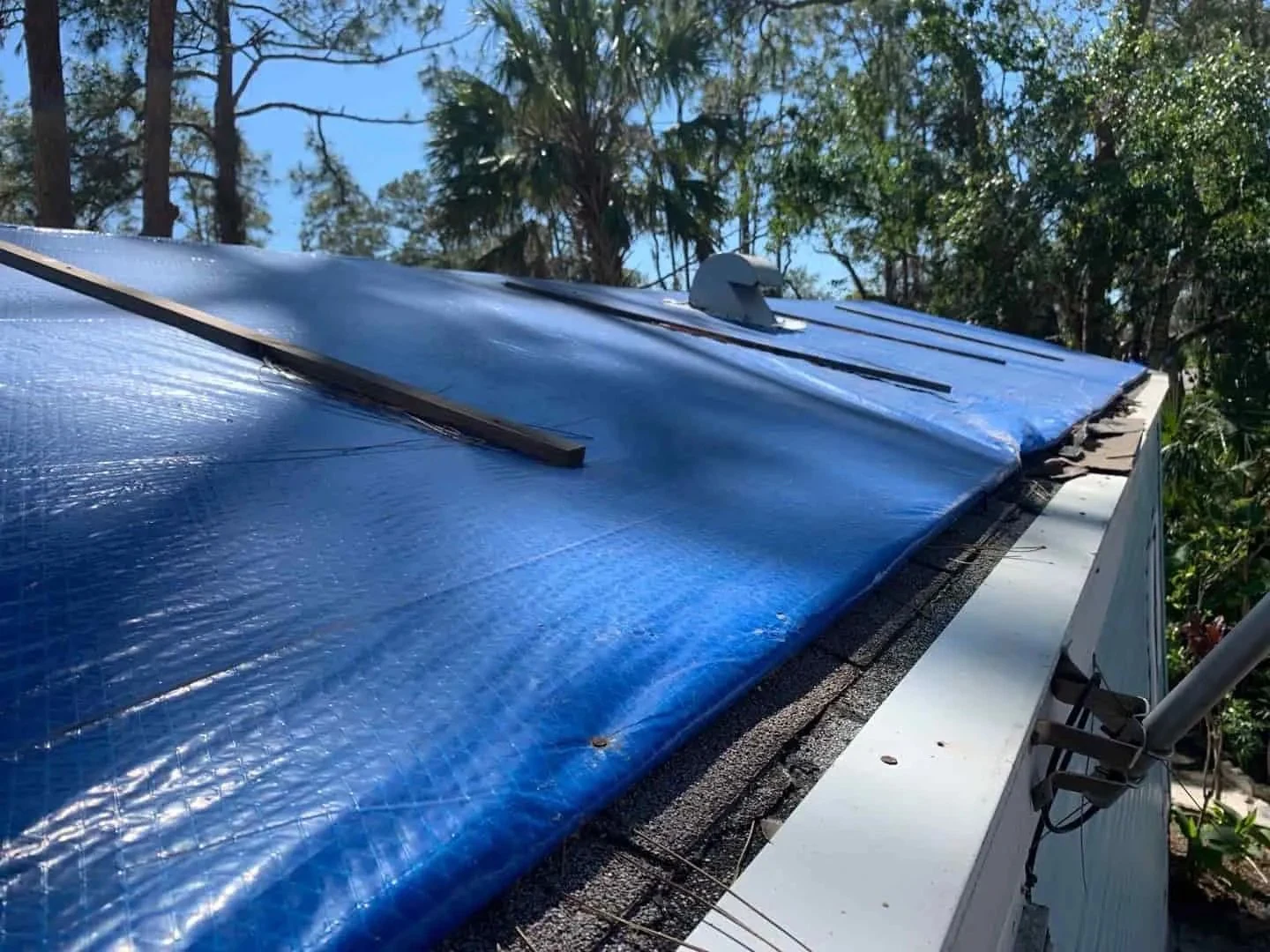
Emergency Roof Tarp & Dry-In in Roanoke, VA
Emergency Dry-In After Wind and Storm Damage
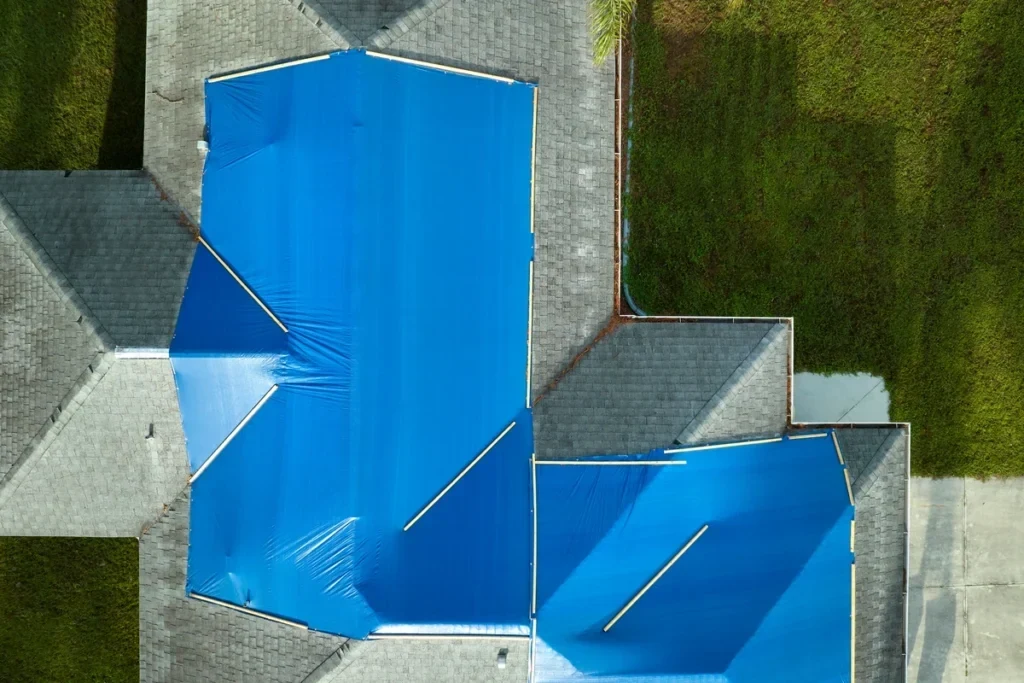
When a section of membrane tears loose or a fallen limb punctures a roof, the priority isn't a permanent fix - it's stopping water from getting into the building right now. A tarp and dry-in gets a damaged section sealed and weathertight fast, buying time to plan the real repair without water damage spreading through insulation, deck, and the ceiling below.
What Causes These Calls in the Valley
Wind is the most common trigger. Sustained wind funneling through the valley or gusting off the ridgelines can lift a membrane edge that's already had years of fastener backout, tearing a section loose in a single storm. Hail from summer thunderstorms rolling off the Blue Ridge can puncture aged or brittle membrane. Ice buildup during winter systems occasionally cracks flashing or shifts a section of edge metal enough to open a gap.
Falling limbs are a factor too, especially on properties with mature tree cover near Mill Mountain or the wooded fringes of the valley, where a storm-weakened branch can come down on a roof section with enough force to puncture the membrane and sometimes the deck underneath.
Buildings Where Speed Matters Most
Not every building faces the same consequences from a delayed tarp. A warehouse near the I-81 corridor storing palletized dry goods can tolerate a short delay better than a facility with sensitive contents. We treat calls involving cold storage, server rooms, or any space with equipment vulnerable to water differently, moving those to the front of the queue regardless of what else is scheduled that day.
We also factor in occupancy. A medical office affiliated with the regional healthcare network has patients and staff on site during business hours, and an active leak there carries a different urgency than the same leak in an unoccupied storage building overnight.
How We Handle an Emergency Call
We assess the damage extent first - how large an area is compromised, whether the deck itself is exposed, and whether water is actively entering the building. From there we secure the area with reinforced tarping, anchored to withstand continued wind rather than a flat sheet that'll just tear loose again in the next gust. Where the deck itself is exposed, we prioritize covering that over cosmetic membrane concerns, since an open deck in a storm is the real risk to the building interior.
Interior protection matters too. If water has already gotten in before we arrive, we'll flag areas that need moisture monitoring so mold risk doesn't become a secondary problem on top of the roof damage itself.
- Rapid damage assessment to determine exposed deck area
- Reinforced tarping anchored for continued wind exposure
- Priority coverage of any exposed structural deck
- Interior water intrusion flagged for moisture monitoring
- Photo documentation for insurance claim support
- Scheduling for permanent repair once conditions stabilize
Documentation for Insurance
We photograph the damage extent and the tarp work itself before and after, giving you a documented record for an insurance claim. We describe what we found and what we did factually - we don't promise claim outcomes, since that's between you and your carrier, but we make sure the documentation supports whatever claim you file.
From Tarp to Permanent Repair
A tarp is a stopgap, not a solution. Once the immediate weather threat passes, we schedule the permanent repair - which might be a membrane patch, a section replacement, or in more severe cases a recommendation toward broader reroofing if the damage revealed underlying issues with an aging roof. We don't let a tarp sit indefinitely as a substitute for the real fix, since prolonged tarping itself can trap moisture and cause secondary damage. We give you a realistic timeline for the permanent repair at the time we tarp, so the emergency response has a clear endpoint rather than becoming an open-ended arrangement.
Response Availability
Storm damage doesn't happen on a schedule, and we treat active water intrusion calls with urgency, particularly for buildings with sensitive operations - medical facilities, cold storage, server rooms - where water reaching equipment is a much bigger problem than the roof damage itself.
Emergency Service Questions
How quickly can you get a tarp on an active leak?
We prioritize active water intrusion calls and move as fast as conditions and crew availability allow. Severe weather itself can sometimes delay response until wind or lightning risk passes enough for crews to safely get on the roof.
Will the tarp hold up until the roof can be permanently repaired?
A properly anchored tarp can hold through additional weather events, but we don't recommend leaving it in place indefinitely. We schedule the permanent repair as soon as it's safely and logistically possible.
Do you work directly with insurance adjusters?
We provide documentation and can walk an adjuster through the damage we found, but the claim itself is between you and your insurer. We stick to factual reporting of conditions and repairs.
What if the damage is worse than it first appears?
That happens more often than not once a tarp goes up and we can assess more thoroughly. We'll update you on scope changes before proceeding with anything beyond the immediate stabilization.
Can a tarp cause additional damage if left too long?
Yes, trapped moisture under a tarp over an extended period can encourage mold or further deck deterioration, which is why we treat tarping as a bridge to permanent repair, not an endpoint.
Ready to review the roof scope?
Request a Roof Assessment
Emergency Commercial Roof Repair in Roanoke
When a section of membrane tears loose or a fallen limb punctures a roof, the priority isn't a permanent fix - it's stopping water from getting into the building right now. A tarp and dry-in gets a damaged section sealed and weathertight fast, buying time to plan the real repair without water damage spreading through insulation, deck, and the ceiling below.
What Causes These Calls in the Valley
Wind is the most common trigger. Sustained wind funneling through the valley or gusting off the ridgelines can lift a membrane edge that's already had years of fastener backout, tearing a section loose in a single storm. Hail from summer thunderstorms rolling off the Blue Ridge can puncture aged or brittle membrane. Ice buildup during winter systems occasionally cracks flashing or shifts a section of edge metal enough to open a gap.
Falling limbs are a factor too, especially on properties with mature tree cover near Mill Mountain or the wooded fringes of the valley, where a storm-weakened branch can come down on a roof section with enough force to puncture the membrane and sometimes the deck underneath.
Buildings Where Speed Matters Most
Not every building faces the same consequences from a delayed tarp. A warehouse near the I-81 corridor storing palletized dry goods can tolerate a short delay better than a facility with sensitive contents. We treat calls involving cold storage, server rooms, or any space with equipment vulnerable to water differently, moving those to the front of the queue regardless of what else is scheduled that day.
We also factor in occupancy. A medical office affiliated with the regional healthcare network has patients and staff on site during business hours, and an active leak there carries a different urgency than the same leak in an unoccupied storage building overnight.
How We Handle an Emergency Call
We assess the damage extent first - how large an area is compromised, whether the deck itself is exposed, and whether water is actively entering the building. From there we secure the area with reinforced tarping, anchored to withstand continued wind rather than a flat sheet that'll just tear loose again in the next gust. Where the deck itself is exposed, we prioritize covering that over cosmetic membrane concerns, since an open deck in a storm is the real risk to the building interior.
Interior protection matters too. If water has already gotten in before we arrive, we'll flag areas that need moisture monitoring so mold risk doesn't become a secondary problem on top of the roof damage itself.
- Rapid damage assessment to determine exposed deck area
- Reinforced tarping anchored for continued wind exposure
- Priority coverage of any exposed structural deck
- Interior water intrusion flagged for moisture monitoring
- Photo documentation for insurance claim support
- Scheduling for permanent repair once conditions stabilize
Documentation for Insurance
We photograph the damage extent and the tarp work itself before and after, giving you a documented record for an insurance claim. We describe what we found and what we did factually - we don't promise claim outcomes, since that's between you and your carrier, but we make sure the documentation supports whatever claim you file.
From Tarp to Permanent Repair
A tarp is a stopgap, not a solution. Once the immediate weather threat passes, we schedule the permanent repair - which might be a membrane patch, a section replacement, or in more severe cases a recommendation toward broader reroofing if the damage revealed underlying issues with an aging roof. We don't let a tarp sit indefinitely as a substitute for the real fix, since prolonged tarping itself can trap moisture and cause secondary damage. We give you a realistic timeline for the permanent repair at the time we tarp, so the emergency response has a clear endpoint rather than becoming an open-ended arrangement.
Response Availability
Storm damage doesn't happen on a schedule, and we treat active water intrusion calls with urgency, particularly for buildings with sensitive operations - medical facilities, cold storage, server rooms - where water reaching equipment is a much bigger problem than the roof damage itself.
Emergency Service Questions
How quickly can you get a tarp on an active leak?
We prioritize active water intrusion calls and move as fast as conditions and crew availability allow. Severe weather itself can sometimes delay response until wind or lightning risk passes enough for crews to safely get on the roof.
Will the tarp hold up until the roof can be permanently repaired?
A properly anchored tarp can hold through additional weather events, but we don't recommend leaving it in place indefinitely. We schedule the permanent repair as soon as it's safely and logistically possible.
Do you work directly with insurance adjusters?
We provide documentation and can walk an adjuster through the damage we found, but the claim itself is between you and your insurer. We stick to factual reporting of conditions and repairs.
What if the damage is worse than it first appears?
That happens more often than not once a tarp goes up and we can assess more thoroughly. We'll update you on scope changes before proceeding with anything beyond the immediate stabilization.
Can a tarp cause additional damage if left too long?
Yes, trapped moisture under a tarp over an extended period can encourage mold or further deck deterioration, which is why we treat tarping as a bridge to permanent repair, not an endpoint.
Define scope and pricing boundaries
A proposal should distinguish verified quantities from allowances and investigation from construction. Roof area, repair limits, test cuts, wet-material removal, deck repair, drain work, equipment coordination, and interior protection can carry different pricing certainty. Schedule assumptions also belong beside price: weather windows, material lead time, permits, shutdowns, tenant coordination, daily dry-in, and access restrictions. An unexplained low number can become an expensive sequence of changes if these constraints are omitted. Closeout requirements should be priced as part of the work: final photographs, repair locations, warranty or material records, open punch items, and the next recommended inspection. Those documents keep the completed scope connected to the roof plan.
Why local exposure changes the field plan
A Roanoke roof review has to account for heavy thunderstorms, tropical remnants, wind-driven rain, heat, and freeze-thaw transitions. Those conditions affect access, observation timing, drying, and temporary protection before they affect the final recommendation. Start with the room, ceiling grid, equipment, wall line, and time of entry, then carry those coordinates to the roof. Comparing high and low points, rooftop details, prior patches, and flow paths is more reliable than standing over the first wet-looking surface. A useful report does not hide uncertainty. It names the unverified areas, explains why they were inaccessible, and states which follow-up observation or test would resolve the question.
Document the condition before choosing the scope
The core deliverable is a record of interior leak locations, roof access, water paths, membrane and flashing defects, drainage conditions, temporary work, and photographs taken before conditions change. Commercial Roofing of Roanoke should be able to hand that record to ownership, a facility manager, or another contractor without a separate verbal explanation. The field sequence is to stabilize the immediate opening, protect the occupied area, and document the conditions that still require permanent work. Photographs should show context and detail, and test locations should explain what question was being answered and how the opening was closed. Temporary protection, permanent repair, routine maintenance, and capital recommendations belong in separate sections. This keeps a successful dry-in from being mistaken for the completed repair and lets competing proposals be compared on the same basis.
Treat each roof assembly on its own terms
EPDM White, Spray Polyurethane Foam, and TPO 60 Mil can show a similar interior symptom while requiring different investigation and repair details. The observed assembly-not a generic flat-roof label-has to control the scope. The scope should name the membrane or surface that was actually observed, identify unknown construction, and check compatibility before mastics, primers, membranes, or coatings are specified. Core information may be necessary when layers and attachment affect the option set. Drainage stays in the analysis because a sound patch cannot correct water held against a curb, an overloaded outlet, or settlement at a low point. System language should support what is temporary, what can be repaired permanently, and what requires a broader inspection after the weather clears instead of functioning as a product catalog.
Roof work has to fit real operations
A technically correct detail is only part of the job at Roanoke properties such as Healthcare Systems, Property Management Firms, and Government Public Sector. The plan also has to protect people, inventory, equipment, and normal access below the roof. Access and protection notes should cover ladders or hatches, staging, falling-object zones, odor and noise, equipment clearances, daily cleanup, weather stops, and the rooms directly below openings or test cuts. Operating controls are roof-quality controls. Water, debris, odor, noise, or an unsecured access point can harm the owner even when the installed detail itself is correct, so those risks need owners and closeout checks.
Make repair, restoration, and replacement distinct decisions
Before pricing becomes the focus, ownership needs an answer to what is temporary, what can be repaired permanently, and what requires a broader inspection after the weather clears. That answer should define the boundary between service work and a capital project. The option matrix should address present failure, remaining risk, investigation still required, installation disruption, anticipated service interval, and future maintenance. Unknown inputs should be visible rather than buried in an allowance. Ownership should be able to see why a roof can be maintained, why it qualifies for restoration, or why removal is necessary. The report earns that conclusion through field evidence rather than sales urgency.
Turn the visit into a usable next step
After this scope, the record should advance to a documented roof inspection once the immediate water entry is controlled. Carrying the same roof-zone names and evidence forward prevents the next visit from starting with an empty file. For one building, that history makes the next visit faster and reveals whether a repair held. Across a portfolio, it lets ownership rank roofs by condition, operational risk, repair spending, and capital timing instead of reacting to the newest ceiling stain. Commercial Roofing of Roanoke can keep inspection and maintenance active while repair, restoration, or replacement moves through a separate project opportunity. The path remains response, evidence, the right scope, closeout, and the next scheduled roof decision.
A useful response starts before roof access
Before dispatch, collect the address, responsible building contact, safe access route, occupied area below the problem, time and behavior of the leak, known roof type, and any temporary protection already attempted at the Roanoke property. The caller should not be asked to diagnose the assembly from the floor. A short description of timing, location, volume, affected equipment, and previous occurrences is more useful than guessing which roof product failed. Clear intake notes reduce wasted roof time and prevent the handoff from losing urgent details. They also create the first event in the roof history that later inspections and repair records can reference.
Roanoke decision checklist
- Map the interior symptom to a named roof area before selecting a repair detail.
- Record temporary measures separately from permanent work and list every open item.
- Verify drainage, penetrations, walls, edges, earlier repairs, and transitions around the affected area.
- State the observed roof assembly, unknown construction, access limits, and testing assumptions.
- Connect the recommendation to repair, restoration, replacement, maintenance, or capital-planning thresholds.
- Set the next inspection or follow-up date so the roof history continues after this visit.
Commercial roof decision questions
Does this condition automatically mean the roof must be replaced?
No. The review should establish what is temporary, what can be repaired permanently, and what requires a broader inspection after the weather clears. Replacement becomes a defensible recommendation only when the field evidence, moisture, assembly condition, repair history, deck or attachment concerns, and lifecycle comparison support it.
What should the Roanoke roof scope document?
It should document interior leak locations, roof access, water paths, membrane and flashing defects, drainage conditions, temporary work, and photographs taken before conditions change. It should also label temporary and permanent work separately, state assumptions and exclusions, and identify the inspection or service step that follows the current scope.
How does an urgent call become a maintenance or capital plan?
The immediate visit creates the first roof-area record. A follow-up inspection establishes condition and priorities. Completed repairs, recurring observations, drain service, warranties, and future recommendations are then retained so maintenance stays scheduled and larger work can be placed into the appropriate capital year.
From service call to roof plan
Use the next decision, not the biggest sale.
Stabilize the problem, document the roof, compare the viable paths, and keep the resulting roof history active.
Request commercial roof help