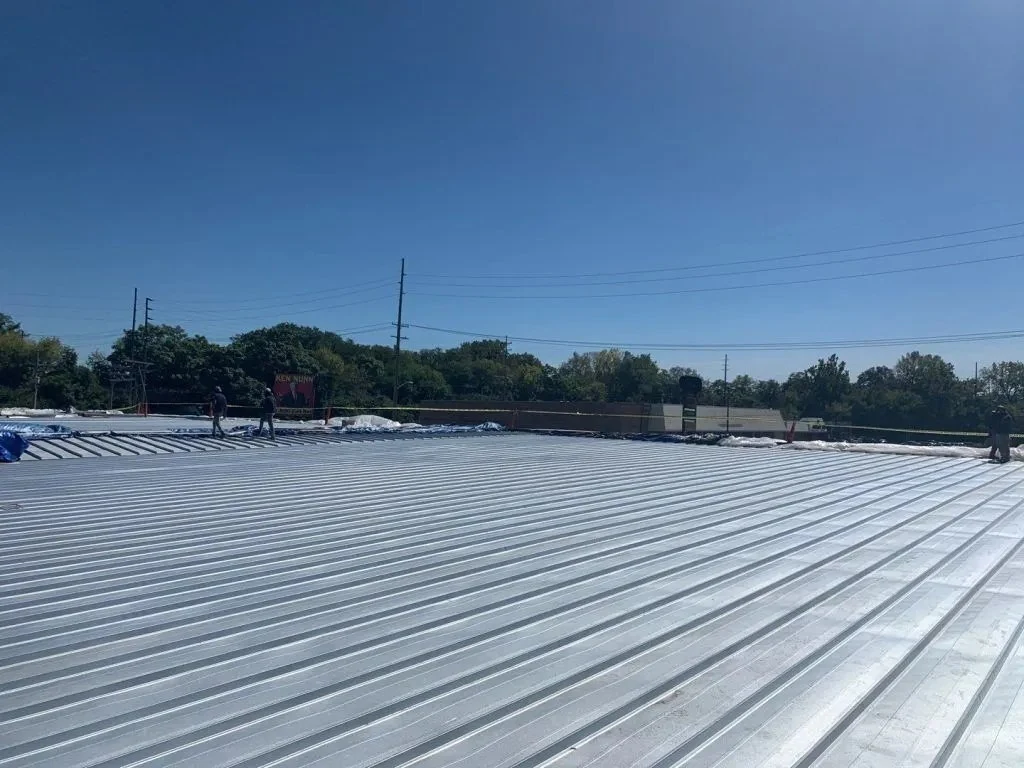
Standing seam metal roofing shows up on Roanoke manufacturing buildings, institutional campuses, and steeper-slope commercial structures where its concealed-fastener design and long service life justify the higher installed cost compared to membrane systems. We install and repair standing seam systems with clip spacing and panel selection matched to the wind exposure of the specific site, not a generic manufacturer default.
Standing seam panels attach to the deck through clips hidden under the raised seam, rather than exposed fasteners punched through the panel face. That design eliminates the most common failure point on exposed-fastener metal roofs, which is fastener backout and gasket degradation at every screw penetration over the roof's field. On a standing seam system, the only fasteners exposed to weather are at the perimeter and penetrations, which is a much smaller population of points to maintain.
That advantage matters more on buildings that plan to hold the roof for thirty-plus years, since a standing seam system's floating clip design also lets the panel expand and contract with temperature swings without stressing the fastener, which is a real factor across Roanoke's seasonal temperature range from humid summer heat to winter cold snaps.
Clip spacing, along with clip type, determines a standing seam roof's wind uplift resistance, and that spacing needs to reflect where the building actually sits in the valley. A manufacturing building near a ridge-adjacent industrial park or sited where the terrain funnels wind, such as buildings closer to the gap the Roanoke River cuts on its route through the valley, needs tighter clip spacing at the field and especially at corners and perimeter zones than an equivalent building sheltered deeper in the valley floor.
We calculate clip spacing from the site's actual exposure category rather than defaulting to a standard 24-inch layout across the board. Getting this wrong is invisible until the first major wind event, at which point it becomes a very visible and very expensive problem.
Panel width, seam height, and material gauge all affect a standing seam roof's performance under snow load and wind. We factor in the higher elevation snow bands that hit buildings near Mill Mountain, Poor Mountain, and the Bent Mountain plateau earlier and heavier than the valley floor sees, which changes structural loading assumptions on roofs at those elevations compared to a downtown building at lower elevation.
Long metal panel runs, common on manufacturing buildings with large uninterrupted roof planes, need properly placed expansion joints to accommodate thermal movement across a full seasonal temperature swing. Skipping or under-sizing expansion joints on a long run leads to oil-canning, panel buckling, or clip failure over time as the metal repeatedly pushes against fixed points it was never designed to push against.
We calculate expansion joint placement based on total panel run length and the specific alloy's thermal expansion rate, then verify clip movement isn't restricted at fixed points during installation, since a single improperly fixed clip can compromise the whole run's ability to move as designed.
A lot of our standing seam work is repair and retrofit rather than new installation. Common issues include failed sealant at ridge caps and endwalls, clip fatigue at expansion points, and panel damage from fallen limbs or hail. We match repair materials and profiles to the existing system wherever possible rather than defaulting to a generic patch that stands out and performs differently from the surrounding panels.
Institutional buildings around the valley, including school and municipal structures with standing seam roofs installed decades ago, often need a full clip and sealant survey before an owner commits to a repair budget. We walk the entire roof rather than sampling a few sections, since clip fatigue tends to cluster near expansion joints and eave transitions that a partial inspection can easily miss.
For buildings planning to hold the roof for 30 or more years, or for architecturally exposed applications where appearance matters, yes. For a straightforward low-slope warehouse with a shorter ownership horizon, membrane usually pencils out better.
Oil-canning is usually a sign of restricted thermal movement, either from expansion joints spaced too far apart or a clip that's fixed when it should float. We assess the run length and clip layout to identify where movement is being blocked.
Yes. Wind exposure varies meaningfully across the Roanoke Valley based on terrain and site position, and clip spacing at corners and perimeter zones should reflect the actual exposure category of the building, not a standard layout.
Sometimes, if the existing structure can support the added weight and provides a suitable attachment substrate. We evaluate structural capacity before recommending a retrofit panel system over tear-off.
That's typically an exposed-fastener panel system, where repeated thermal cycling gradually works screws loose over the roof's field. It's one of the main reasons standing seam's concealed-fastener design outperforms exposed-fastener systems over a long service life.